Overview
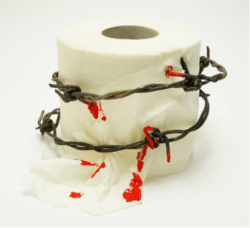
Anal fissures are tears on the lining of the anal canal or the anus. These fissures can be very painful and can cause bleeding. The pain intensifies during bowel movements and you can feel a tearing sensation on your anal skin.
Anal fissures mostly occur due to hard, large stools and chronic constipation. Though older adults are at high risk for developing anal fissures, it is more common among children, teenagers, and adults between the age of 20 to 40.
During the early stages of anal fissures, the pain generally goes away after the bowel movement. You can get better with a high-fiber diet, medications, and ointments. But as the symptoms progress, even if you are having soft stools, the pain persists for hours throughout the day. The stool softeners and ointments no longer help.
Generally, anal fissures can be healed with conservative treatments. But if the pain worsens and you start noticing skin flaps or growths in the anal region, it is time to face the fact, that you need surgery.
For some people, the mere idea of surgery can be frightening and they may try to avoid it by all means. People may experience thoughts like:
- Will I be able to recover completely?
- Am I going to develop post-surgical complications?
- How long will I be on bed rest?
- When will I be able to get back to work?
If you are someone who is having these thoughts, let me assure you that contrary to open surgery, laser fissure surgery is completely safe. Recovery is fast, complications from surgery are negligible, and you can get back to work within a few days.
What is laser fissure surgery?
A fissure surgery is a standard operation and the procedure is very simple. The objective is to:
- Remove the obstacles like the pathological growths from the canal and the anus that obstructs the smooth passage of stools.
- To convert deep wounds into shallow flat wounds.
- Restore elasticity of the anal sphincter.
- Dissolve scarring tissues.
- Seal the wound edges to reduce bleeding.
- Examination to rule out malignant tissue degeneration.
During surgery:
During a laser treatment, a diode laser is inserted into the anal opening. The surgeon then moves the laser towards the fissure. A small incision is made to loosen the anal sphincter muscles and reduce spasms. The scars are dissolved and the wound edges are sealed. The procedure also removes obstructions in the anal canal. The infrared radiation also increases the blood flow in the region and induces proper healing.
Laser anal fissure surgery is a day-care procedure and hardly takes half an hour. Patients are released after one or two days.
Since a diode laser is used instead of an electric scalpel, it gives better results and accuracy. Wound healing is faster and the scars become smooth. The procedure is done under local anesthesia. Post-op pain is very less and can be managed by painkillers.
After surgery:
- The surgeon does not apply sutures to the wound site.
- You may be discharged immediately or require hospitalization for one or two days depending on your overall health and healing.
- The wound site is left open allowing discharge of secretions for faster healing.
- After every bowel movement, clean the area with running water. You can also use alcohol-free baby wipes.
- Soak the area in warm water for 20 minutes or take a hot bath to reduce pain and swelling. Repeat this 3 to 4 times a day.
- Apply ointments regularly as prescribed by your physician.
- Take a fiber-rich diet to reduce constipation. Too much intake of painkillers can increase constipation.
- For the first few days, it is advisable to keep the anal area free. Infants can wear diapers. Parents and caretakers must change the diapers often to keep the area clean and reduce friction.
- You may resume normal daily activities but do not exert yourself. Doctors advise taking rest for one to two weeks before going to work for proper healing of the wound site.

What is the success rate of laser fissure surgery?
Laser treatment for fissures has higher success rates than open fissure surgery. Laser fissure surgery has been found to be 99-100% successful in curing patients. The risks for recurrence are very less, around 1% to 2 %.
Benefits of laser fissure surgery
- Minimally-invasive procedure.
- Painless surgery.
- Minimal bleeding.
- Faster recovery.
- Very low risk for recurrence.
- Scars are aesthetically healed.
- Reduces chances for infections and other side effects.
- No stitches.
- Can resume daily activities the next day.
- Lowers the time for hospital stays compared to traditional open fissure surgery.
- Reduced risk for fecal leakage or incontinence.
- Minimal to no post-surgical pain.
- Easy procedure.
- High success rate.
Stop your suffering NOW
Don't just jump into a surgery because your doctor is advising you to go for it. Consult our doctors to know if you need a surgery at all. Rest assured, we WON'T recommend you surgery unless it's the last resort.